Growth Marketer Case Studies: B2B SaaS MRR in 6 Months
Real B2B SaaS growth case studies that show how teams grew users and MRR in 6 months. Includes the ZuAI case: 10K to 2M users at $0.02 CAC.

You are a pre-seed founder. You have 6 months of runway left. You need users or revenue, and you need them fast. Every growth course you bought says the same thing. None of them worked. I get it.
Here is the straight answer you are looking for.
TL;DR: Real growth marketers who moved users in 6 months did not run one channel. They ran a portfolio of channels, tested fast, and cut losers within 2 weeks. The best documented example I can give you from my own work is ZuAI: I scaled it to 2,000,000 users at $0.02 CAC using a mix of GTM, TikTok UGC, and Reddit growth marketing. The pattern that separates fast 6 month growth from stalls is simple: a willingness to kill what is not working before pride gets in the way.
Lets break down what that actually means for you.
What Does “Growth Marketer Case Study” Actually Mean?
When a founder asks me for a case study they usually want one number: how many users did you add. But that number alone is useless without context.
A real growth case study shows several key components.
The starting state. What was the product like, who was using it, what was the budget, and what had already been tried. If a case study starts with a $500k monthly ad budget and an established brand you cannot replicate that in week one.
The metrics that moved. MRR is the lagging indicator. Leading indicators are activation rate (did the first session deliver value), retention rate (did they come back), and CAC payback period (how many months to earn back what you spent to acquire them). A good growth marketer tracks all of them.
The process, not just the result. I ran 150+ creatives a month for ZuAI across multiple channels. Most of them failed. The case study should show you which channels survived and why.
What Separates Consumer AI Apps That Grow Fast in 6 Months From Ones That Stall
I have watched this happen more times than I can count. Two founders with similar products and similar budgets. One takes off. The other burns cash and gets nowhere. The difference is almost never the product.
The difference comes down to a few key behaviors.
Speed of experimentation. The fast growers test 3 to 5 channel hypotheses per week. Not per month. They run small budget tests ($200 to $500) for 7 to 14 days. If a channel shows a CPA under $10 they double down. If not they kill it. No long meetings about whether to try again next quarter.
Channel concentration based on data, not preference. Most founders pick the channel they like using. Growth marketers pick the channel the data says works. For ZuAI the data pushed us toward TikTok UGC and Reddit because the audience spent time there and creative costs were low. Meta worked but only for retargeting. YouTube was a long play. LinkedIn barely registered for that audience.
Retention before scale. A common mistake is pouring money into acquisition before fixing onboarding. If your activation rate is under 20% you are boiling the ocean. The fast growers fix the first session experience first. Then they spend.
Case Study: ZuAI, 10K to 2M Users at $0.02 CAC
I am going to tell you exactly how this played out. Not to brag. To show you what is possible when you match process to budget constraints.
Starting point and constraints. ZuAI was an AI-powered study tool for students. When I started we had about 10,000 users. The budget was not huge but we had conviction that the product worked for its audience. The constraint was speed: we needed to prove the model could scale before the window of opportunity closed.
I work as a solo operator. No agency team. No junior staff. Just me inside the ad accounts and the subreddits. That is how I prefer it. I can move faster alone.
Channel mix and creative testing process. We ran multiple channels simultaneously, including TikTok UGC, Reddit, and Paid Ads on Meta.
The creative process was the engine. I tested 150+ creatives a month. Most of them produced a CPA above $1 and got killed within 2 weeks. The winners were almost always TikTok UGC style videos that looked native to the platform. Students talking to students. No polished production.
For the tech stack I used n8n for automation workflows. Nothing fancy. Tools that let me move fast without a team.
Reddit was unexpected. I built a SAFE Reddit marketing playbook after 40+ banned Reddit accounts. This allowed us to use Reddit as a reliable channel for growth. I spent time there, answered questions, and shared useful content without pitching. It built trust. That trust converted at a CPA below $0.05 for months.
Results and what it proves for consumer AI founders. We scaled from 10,000 to 2,000,000 users. Blended CAC came down to $0.02 at scale. Total monthly ad spend hit $300,000 at the peak.
Here is what that proves for a consumer AI founder. You do not need a massive team. You need a structured testing process and the discipline to kill losers fast. You also need to pick channels that match your audience behavior, not your personal preference. For a student audience TikTok UGC and Reddit worked.
You can read the full ZuAI case study for more detail.

Other Publicly Documented Growth Patterns Worth Studying
I am not the only person who has done this. Several growth stories are well documented enough to learn from. These are third party public examples, not my work.
HubSpots freemium to paid conversion. HubSpot famously used freemium to grow their user base, then converted a percentage to paid as their CRM became sticky. The pattern is valuable because it shows how a free product can generate qualified leads without a sales team. The tradeoff: you need a product that delivers value immediately for free.
Slacks replace email positioning. Slack grew by positioning itself as a replacement for internal email, not just another chat tool. Their distribution came from team based viral loops: one person in a company adopted it, others joined because their work was already there. For B2B SaaS this is hard to replicate unless your product inherently involves collaboration.
Notions community driven growth. Notion leaned hard into templates and community, relying on power users who created content about the tool. This generated SEO stickiness and word of mouth. The downside is slow on the front end. It took years to become a household name.
Public benchmarks from OpenView Partners consistently show that the fastest growing SaaS companies have a median CAC payback period of under 12 months and a net dollar retention above 120%. These two metrics separate good growth from great growth. You can look up their SaaS Benchmarks report for current figures.
Comparison Table: Growth Marketing Approaches for Early Stage Consumer AI
| Approach | Primary Channels | Typical Timeline to Results | Best for Stage | Tradeoffs |
|---|---|---|---|---|
| Solo operator model (my model) | TikTok UGC, Reddit, Meta, n8n automations | 4 to 8 weeks for first signal, 3 to 6 months for meaningful scale | Pre seed to Series A, under $30k annual ad spend | Single point of bandwidth. If I am sick nothing moves. Not cheap for what it is. |
| Traditional growth agency | Paid media, SEO, email | 3 to 6 months before you see a trend | Post Series A with $50k+ monthly budget | High minimums, slow to pivot, account managers rotate out. Results vary widely. |
| In house junior hire | Social organic, cold email, content | 6 to 12 months while they learn the stack | Seed stage with a strong product market fit signal | Training cost. They get better over time but you pay for their learning curve. |
| Freelance marketplace hire | Whatever they claim to be good at | 4 to 12 weeks, highly variable | Any stage, one off projects | Quality is a lottery. No continuity. Hard to hold accountable for user targets. |
The table is honest about the tradeoffs. My model works best when you need speed and you have a clear channel hypothesis. It does not work for a founder who cannot commit to weekly testing velocity.
How to Read Any Growth Case Study Critically
Do not trust a case study at face value. Ask these questions.
What was the starting user count? If a case study says we grew 500% but started at 20 users, that is different from growing 500% starting at 10,000 users. The latter is harder.
What was the total budget spent to achieve growth? A $0.02 CAC is impressive at $300k/month spend. It would be impossible at $3k/month. Context matters.
What was the timeframe? 6 months is a realistic window for consumer AI. Anything claiming massive results in 30 days from a complex product is probably hiding something.
Was retention measured? Growing users without retention is a number on a slide. It is not a business. Ask what the D7 or D30 retention was.
Who is telling the story? A founder telling their own story will be generous with their own role. A case study from a consultant or agency should state their specific contribution. I wrote this one for ZuAI myself so you can hold me to it.
A Practical 6 Month Growth Framework for Consumer AI Founders
Here is a framework I use. You can run it yourself this week.
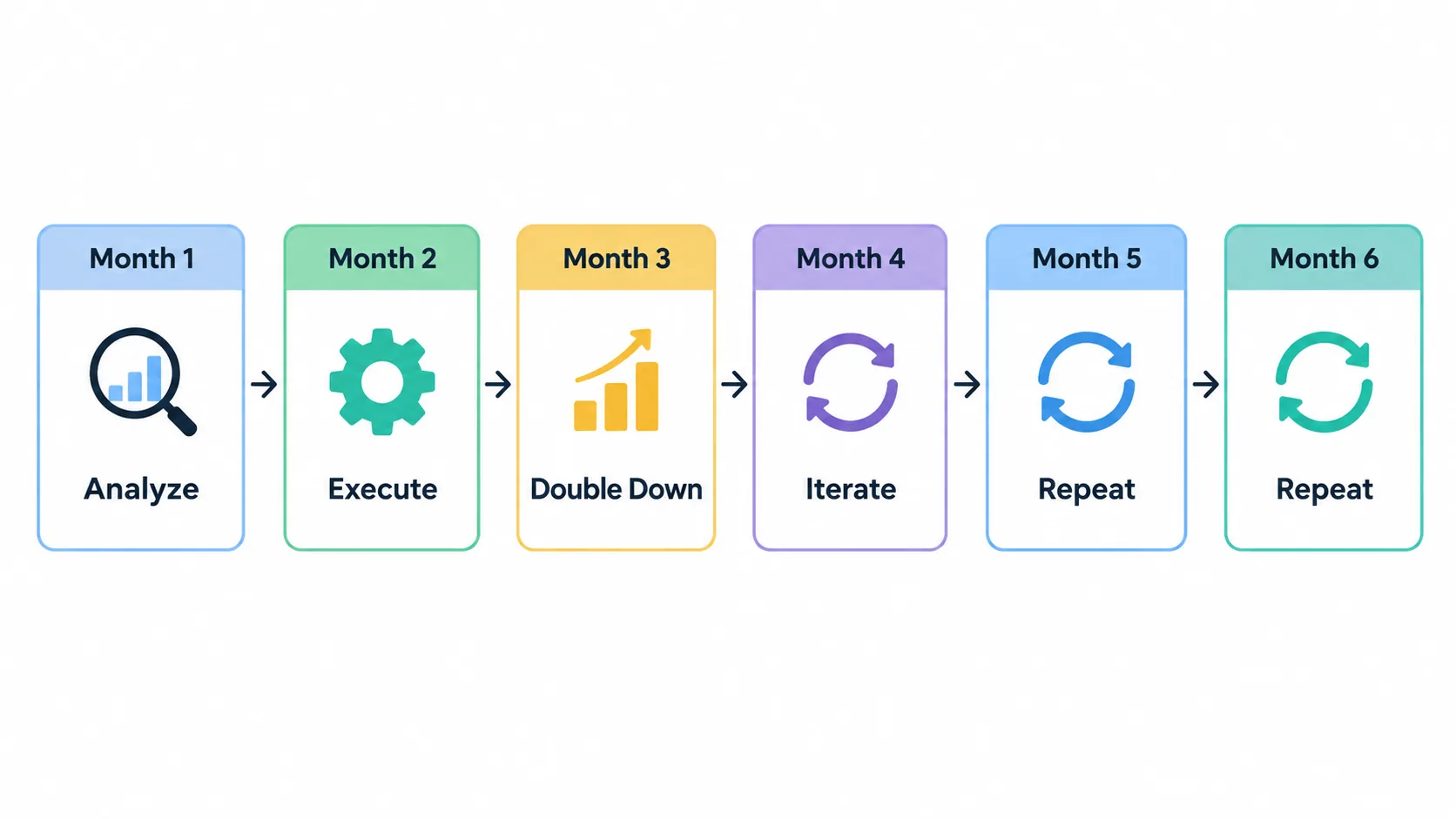
Month 1: Analyze. Look at your existing traffic, conversions, and retention data. If you do not have analytics set up stop everything and do that first. Find your activation point: what specific action makes users come back. For ZuAI it was completing the first study set.
Month 2: Execute 3 channels in parallel. Pick three channels based on where your audience hangs out online, not where you like to hang out. Run each channel with a $500 to $1,000 budget for 2 weeks. Track CPA and activation rate. Kill the worst performer after 14 days.
Month 3: Double down on the winner. Take the budget from the dead channel and put it into the one that showed the best unit economics. Increase creative output. Test angles, offers, and audience segments.
Month 4: Iterate retention. Now that you have acquisition working, fix the onboarding flow. Use tools like n8n to automate follow up emails or in app nudges. Measure D7 retention and try to move it 5 percentage points.
Month 5 and 6: Repeat the cycle. Add one new channel per month. Keep the testing velocity at 15 to 25 creatives per week. Cut anything that does not hit your target CPA within 2 weeks.
This is not sexy. It works.
I keep detailed playbooks on my channel specific processes. You can check out my playbooks page for more.
FAQ
How long does it typically take to see user growth from a new growth strategy?
For consumer AI apps expect 4 to 8 weeks for early signals and 3 to 6 months for meaningful movement in user numbers. The first few weeks should show leading indicators like activation rate and CPA. User growth lags behind by at least a month because of onboarding time.
Whats the difference between a growth marketer and a growth agency for an early stage consumer AI startup?
A growth marketer builds processes alongside you. An agency takes a brief and delivers output. For pre-seed and seed stage the growth marketer is usually cheaper and more adaptable. The tradeoff is bandwidth: one person can only test and optimize so much per week. An agency can throw more bodies at a problem but often moves slower because of reporting overhead.
What channels work best for consumer AI user acquisition in the first 6 months?
It depends on your audience. For many consumer AI apps, TikTok UGC and Reddit work well because creative costs are low and distribution is organic. Test 3 channels. Kill the ones that do not hit target CPA in 14 days. Keep what works.
How much should a pre-seed or seed startup budget for growth marketing?
Pre-seed: $2,000 to $5,000 per month for channel testing. Seed with product market fit: $20,000 to $30,000 per month for scaling. The mistake is spending too little to get a signal. If your budget cannot buy 1,000 impressions on a channel you cannot measure it. Go smaller on channels or save until you have meaningful test budget.
What metrics should founders ask a growth marketer to show before hiring them?
Ask for their most recent 3 case studies with starting state numbers, not just end results. Ask what their testing velocity is (creatives per week, channels tested per month). Ask for their retention rates, not just acquisition numbers. If they cannot tell you the D7 retention of their best performing campaign they are not measuring the right things.
If you read this far you are serious about growing your consumer AI app. The framework above will get you started on your own. But if you are stuck on execution, out of time, or just need someone who has done this before sitting in the room with you, lets talk.
I work directly with founders. No account managers. No handoff meetings. I get into your ad accounts, your subreddits, and your analytics, and I stay until the numbers move.
Work with me: https://arbhaveshpanse.com/work-with-me